
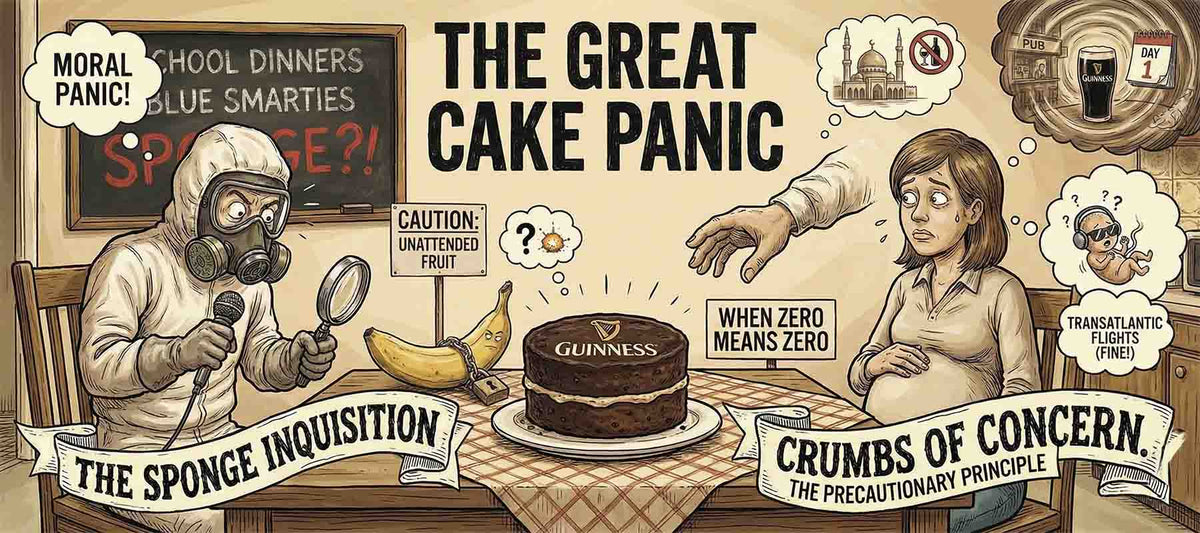
Does alcohol cook out of cake? Not necessarily. Baking can reduce alcohol, but it does not guarantee that every trace disappears. The amount remaining depends on the recipe, cooking time, temperature, surface area and whether alcohol is also added to buttercream, ganache, syrup or filling after baking.
That matters with Guinness cake because the answer is more useful than a breezy “it all burns off”. If a cake is made with Guinness, it should be described clearly as containing an alcoholic ingredient.
Does Guinness Cake Contain Alcohol?
Yes, when standard Guinness or another alcoholic stout is used. The final amount cannot be calculated reliably from the name of the cake alone. Two recipes can use different quantities, bake for different lengths of time and add stout in entirely different places.
Our Chocolate Guinness Cake contains Guinness in the sponge. Anyone who needs to avoid alcohol entirely should choose another cake.
Why Does Some Alcohol Remain After Baking?

Alcohol evaporates during cooking, but food is not a laboratory flask. It is mixed with water, fat, sugar, flour and other ingredients, and evaporation changes according to the cooking method.
The US Department of Agriculture’s nutrient-retention data show that heating reduces alcohol by different amounts depending on time and method. The useful conclusion is not one universal percentage. It is that complete removal should not be assumed.
Alcohol added to an unbaked sponge is also different from alcohol stirred into ganache, frosting or syrup. Components added after baking may retain substantially more of the original alcohol.
Can Children Eat Guinness Cake?

We cannot give a universal medical answer for every child and every recipe. A Guinness cake made with alcoholic stout contains an alcoholic ingredient, even though baking may reduce the amount present.
Parents and guardians should be told clearly what the cake contains. Where there is any concern, or where alcohol must be avoided completely, choose a tested alcohol-free cake instead. Do not rely on comparisons with bananas, bread or fruit juice to make the decision for someone else.
What About Guinness Cake During Pregnancy?

The NHS recommends that people who are pregnant or planning a pregnancy should not drink alcohol. A slice of cake is not the same as a drink, but the exact residual alcohol in an individual recipe is rarely known.
For that reason, we do not describe Guinness cake as categorically safe during pregnancy. The cautious choice is an alcohol-free cake. Anyone concerned about something already eaten should speak to a midwife or doctor rather than rely on a bakery article. Read the current NHS pregnancy guidance.
Religious, Medical And Recovery Considerations
For some people, the issue is not the estimated quantity left after baking. It is the use of an alcoholic ingredient at all.
Requirements differ between individuals, faiths, certification bodies, medical conditions and recovery plans. A bakery should not make a universal religious or medical ruling. If alcohol is prohibited or personally unsafe, choose a product made without it and check the complete ingredients before ordering.
The flavour and knowledge of an alcoholic ingredient can also matter to someone in recovery, regardless of the final alcohol level. Their own recovery guidance should take priority.
Does Guinness 0.0 Solve The Problem?

An alcohol-free stout can be useful, but it should be used in a recipe tested for that ingredient. Check the product label and any dietary or certification requirements that matter to the people being served.
Do not assume that replacing Guinness with Guinness 0.0 will produce an identical sponge. Flavour, sweetness and baking behaviour may change, so the recipe may need adjustment.
The Clear Answer
- Does all alcohol cook out? No complete removal can be guaranteed.
- Does standard Guinness cake contain alcohol? It contains an alcoholic ingredient when made with standard Guinness.
- For children: Tell the parent or guardian and choose alcohol-free where there is concern.
- For pregnancy: Do not make a categorical safety claim; an alcohol-free cake is the cautious option.
- For religious, medical or recovery reasons: Avoid the cake where alcohol must not be used at all.
Cake should be pleasurable, but pleasure is improved by honest labelling. Say what is in it, avoid false reassurance and let people make an informed choice.
Lots of love,
Reshmi xoxo

Comments