
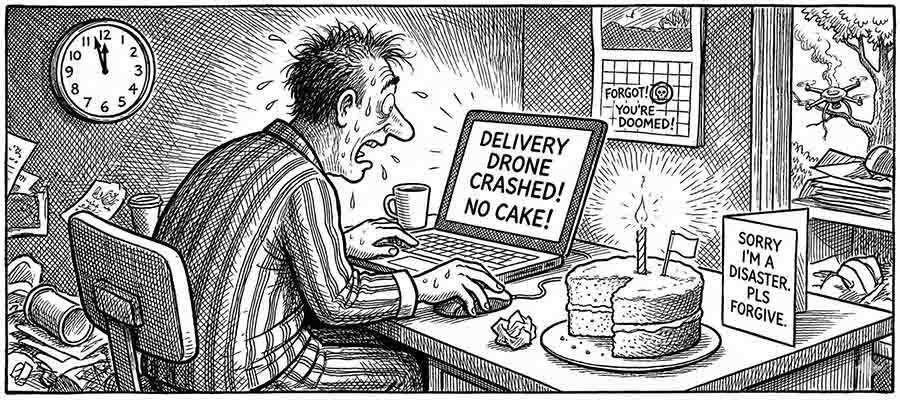
By someone who has spent far too long watching people apologise with sponge
There is a particular kind of silence that arrives at 8:47pm, the night before a birthday. It’s not the cosy hush of the evening settling in, or the gentle domestic quiet of a home that’s finally stopped asking things of you. It’s the silence of a brain doing a sudden inventory.
Candles? Possibly. Card? Somewhere. Cake?
Cake is, very often, nowhere.
And what follows isn’t hunger. No one is seized by a craving for sponge at that hour. What follows is guilt: immediate, thick, slightly sweaty guilt — the sort that makes adults behave like teenagers caught in a lie. It has people hunched over a glowing screen, thumb hovering, as if the Deliveroo app were a confessional and the only penance available is “Add to basket”.
“Can I still get a decent cake for tomorrow?,” they type, as though they’re trying to conjure salvation.
We tell ourselves we buy birthday cakes out of love. Sometimes we do. But more often, if we’re being honest, we buy them out of fear. Fear of being exposed as the person who forgot — or worse, the person who remembered but simply didn’t care enough to act.
A birthday cake is not just dessert. It’s a social repair kit: buttercream and sponge deployed to plaster over a crack you didn’t mean to create — a theme we’ve explored before in why everyone needs a birthday cake. Which is why most birthday cakes aren’t really chosen at all. They are commissioned under duress.
The cake as an edible apology
A birthday cake is rarely about appetite. Nobody wakes up and thinks, with bright-eyed sincerity, what I need today is twelve portions of vanilla sponge. What they want is recognition: proof that they exist in someone else’s mind.

Cake provides evidence. It says: I remembered. And when that’s not strictly true, it says: I realised in time to fix it.
We outsource a staggering amount of emotional labour to flour and sugar. A cake is a way of speaking without speaking. It can carry the sentiment you can’t quite phrase without sounding either too cold or too earnest. It can patch the awkward gap left by a text sent at lunchtime that begins, “Sorry — crazy morning!”
And because cake is public, it performs its apology in front of witnesses. Flowers can be arranged and quietly placed. Wine can be gratefully received and later regifted. Cake, however, must be sliced. It must be offered. It must be eaten by other people, who will nod solemnly and say, “Oh wow, this is lovely,” like a priest granting absolution.
This is why people overspend. It’s rarely extravagance. It’s penance — paid in ganache.
Workplace cakes: ritual under strip lighting
If guilt had a natural habitat, it would be the office kitchen. Not the glossy “wellbeing hub” version companies now try to sell us — no, the real one: the kettle limescaled into resignation, the fridge full of anonymous oat milks, the table that always feels faintly sticky in a way you cannot explain.
Here, the birthday cake becomes theatre.
Someone’s birthday appears in the shared calendar, hovering there like a passive-aggressive ghost. There are only a few outcomes. Either someone steps up, or everyone performs an elaborate dance of plausible deniability until it’s too late and then says, “Oh no — was that today?”
So a cake is bought. Not because anyone truly wants cake at 10:12am on a Tuesday, but because not producing one feels like a small moral failure — often one of those quietly dependable workplace cakes that exist purely to neutralise the situation.
The cake sweats gently under the fluorescents, surrounded by colleagues holding paper plates like shields. Someone finds a knife that isn’t really a knife. Someone says, “Shall we sing?” as if this is a question. Someone else says, “Oh go on then,” and everyone regrets it immediately.

And still, everyone eats the cake. They comment on it. They take a slice “for later” and then abandon it in the fridge like an unanswered email. They wonder, privately, why this ritual survives when we don’t even seem to enjoy it.
But the buyer — whoever they are — feels a wave of relief so palpable you can almost see it. The obligation has been met. The guilt has been neutralised. The sponge has done its work.
Children’s parties: guilt with sprinkles and a receipt
Adult cakes are guilt-driven. Children’s cakes are guilt with a budget line.
There is no modern fear quite like being the parent who didn’t do enough. It doesn’t matter if you’ve shown up every day, packed the lunches, read the books, done the listening, made sure the shoes fit. When it comes to the birthday cake, none of that counts.
The cake becomes the visible receipt of care — something you can point to, photograph, and place at the centre of the table like proof you didn’t just mean well, you spent well.

This is how time becomes money.
You don’t have hours to bake and build and troubleshoot buttercream in your dressing gown, so you buy what time would have produced: something tall, themed, flawlessly iced, and recognisable from the children’s cakes universe. It’s not indulgence. It’s substitution.
Half the children won’t eat it. The birthday child will often peel off the fondant and discard the sponge like a used tissue. None of that matters. The cake has already done its job by arriving, intact, and being seen.
And in the background — always — is the quiet knowledge that someone else’s cake will be on Instagram by lunchtime. You don’t have to say it out loud. The algorithm will do it for you, helped along by an entire ecosystem of birthday cake trends you never agreed to participate in.
Timing and the myth of thoughtfulness
We talk about “thoughtful cakes,” but timing has its own kind of honesty.
A cake ordered three weeks in advance is a gift. A cake ordered at midnight is an admission — and the icing tends to give the game away.

You can see it in the messages people choose when they’re buying late. The wording gets louder, more emphatic, almost desperate: “Best Dad Ever,” “Queen of Everything,” “Legend Since 1987.” The later the order, the more the cake must shout.
It’s overcompensation in buttercream form — one that quietly relies on the fact that delivery still exists.
The tenderness in all this is that the recipient rarely minds. Most people don’t want perfection. They want to be held in someone else’s attention for a moment. Cake does that. Cake turns up. Cake is cut. Cake is shared.
Why we keep buying cakes anyway

If birthday cakes carry so much emotional freight, why do we keep doing it?
Because cake is one of the few socially acceptable ways to say, I’m sorry I didn’t show up in the way I wanted to, without having to say it out loud — something we return to often when talking about why we love birthday cakes so much.
Because cake turns private guilt into public generosity. It allows you to make your apology feel like a gift, which is a clever piece of social engineering when you think about it.
And because, even when it’s bought in a panic, even when it’s chosen badly, even when it’s eaten too quickly or left untouched — cake still creates something. A moment. A pause. A small gathering.
This is the thing we pretend we’re buying when we buy cake: sweetness, celebration, love. Often we’re buying something more complicated. Relief. Repair. The chance to be seen as someone who cares, even if we were briefly distracted by the business of being alive.
We don’t buy birthday cakes because we’re organised. We don’t buy them because we’re saintly. We buy them because we are human: forgetful, slightly ashamed, and quietly hopeful that flour and sugar can smooth things over.
Most birthday cakes are bought out of guilt.
But they are eaten with forgiveness.

Comments