
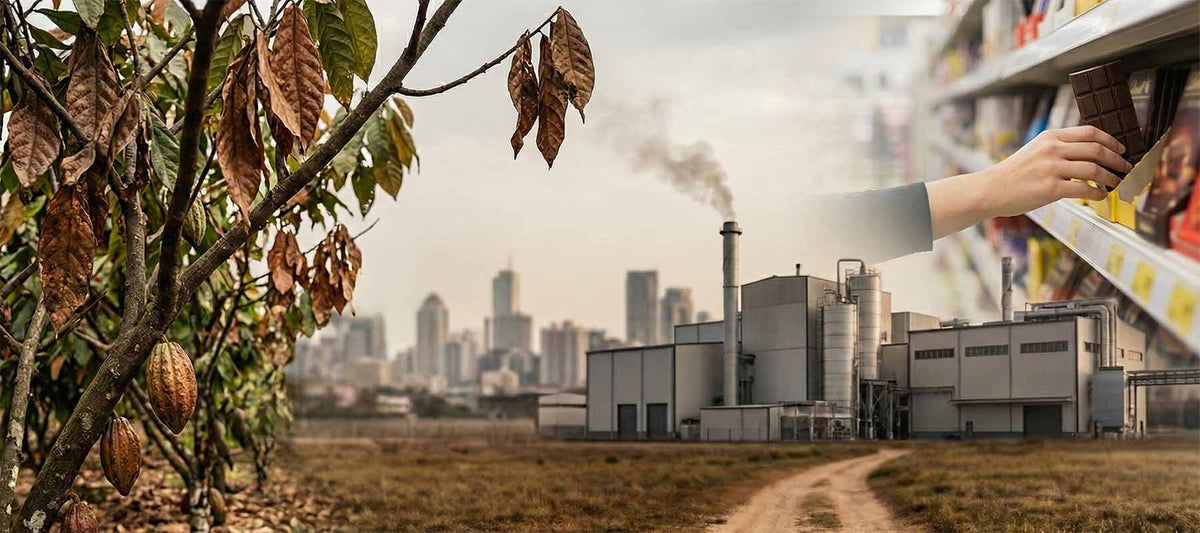
There are few modern shocks more unsettling than discovering that the humble chocolate bar — once a dependable, end-of-day comfort — has crept into luxury territory. Prices have risen sharply, packs have changed size, and shoppers are understandably asking how much of that is really about cocoa.
Updated 15 September 2026: This article has been refreshed with the latest published International Cocoa Organization (ICCO) market data. Where the original version moved from market facts into claims about company motives or future prices, those claims have been removed or clearly separated from what the evidence can actually show.

The cocoa shock was real
The supply squeeze behind the extraordinary cocoa market of 2023/24 was not imaginary. ICCO later estimated world cocoa production for that season at 4.368 million tonnes, down 12.9% year on year, with a global deficit of 494,000 tonnes. Poor weather, crop disease and production problems in major West African growing regions all contributed to a much tighter market.

Cocoa futures subsequently reached exceptional levels. That matters to chocolate makers, but the futures price on a given day is not the same thing as the cost of cocoa in a bar on a supermarket shelf. Manufacturers may buy or hedge cocoa months ahead, contracts roll at different times, and a finished chocolate product also carries the cost of sugar or milk, manufacturing, energy, labour, packaging, transport, retailing and marketing.
By 2024/25, the supply picture had started to improve
The latest ICCO quarterly bulletin available when we updated this article, published in August 2026, estimates 2024/25 world cocoa production at 4.733 million tonnes, up 8.5% year on year. Grindings were estimated at 4.649 million tonnes, down 3.3%, leaving a small estimated surplus of 37,000 tonnes. ICCO also cautions that these figures can be revised and, at that point, had temporarily withheld its 2025/26 production and grindings estimates pending more reliable data.
That is an important change from the shortage narrative of the previous season. It does not mean cocoa is suddenly cheap or that the market is settled. ICCO said futures in April to June 2026 remained sensitive to demand, weather and production risks.
So why can retail chocolate still feel expensive?
Because cocoa is only one part of the final price, and because the route from bean to bar is not instantaneous. There can be a lag between commodity-market moves and what a manufacturer actually pays, just as there can be a lag before lower input costs reach a supermarket shelf. Currency movements, contracts, wages, energy, packaging and retailers' own pricing decisions can all matter too.

That makes a simple claim such as “the cocoa price fell, therefore the chocolate price should fall by the same percentage” unreliable. Equally, a price rise on its own is not evidence that a particular manufacturer has expanded its margin. To establish that, you would need company-specific cost, volume and margin information for the same period.
Shrinkflation is real, but motive is harder to prove
Chocolate is one of many categories in which shoppers have seen pack sizes change. When a pack gets smaller while its shelf price stays the same, the effective price per gram rises. That is worth noticing, and unit pricing is the clearest way to compare like with like.

What we should not do without evidence is pretend every size change has a single motive. Companies may cite input costs, price points, reformulation, packaging or commercial strategy. The useful consumer fact is the price per unit, not a guess about intent.
Higher chocolate prices do not map neatly to farm income
The cocoa supply chain is complicated. Farm-gate pricing systems, forward contracts, local regulation, currency and the timing of purchases all affect what growers receive. A record futures price therefore does not mean every farmer receives that price, just as a higher retail price does not tell us how the extra money is divided through the chain.

What happens next?
We do not know, and that is the point. Cocoa supply can recover or deteriorate; demand can strengthen or weaken; contracts and hedges can delay the effect of either; and retail pricing is a separate commercial decision. The latest ICCO bulletin itself warns that estimates are provisional.
As bakers, we are acutely aware of what happens when high-quality chocolate becomes dearer. As consumers, we are also entitled to notice when packs shrink or shelf prices climb. But the evidence supports a more precise conclusion than the original version of this article: the cocoa shock was severe, the 2024/25 balance improved, and the relationship between commodity prices and the price of a chocolate bar is neither immediate nor one-for-one.
If all this talk of chocolate has left you slightly peckish, our chocolate cake collection is where the subject becomes much more enjoyable.
Sources & further reading
International Cocoa Organization — August 2026 Quarterly Bulletin of Cocoa Statistics
International Cocoa Organization — August 2025 Quarterly Bulletin of Cocoa Statistics



Comments