
Food-safety note: Mature fruit-cake storage depends on the tested recipe, moisture level, alcohol content, wrapping and storage conditions. Alcohol can reduce some spoilage risks but does not make a cake immune to mould or contamination. Discard a cake showing mould, an unpleasant or unexpected smell, sliminess, bubbling, leaking or unusual wetness.
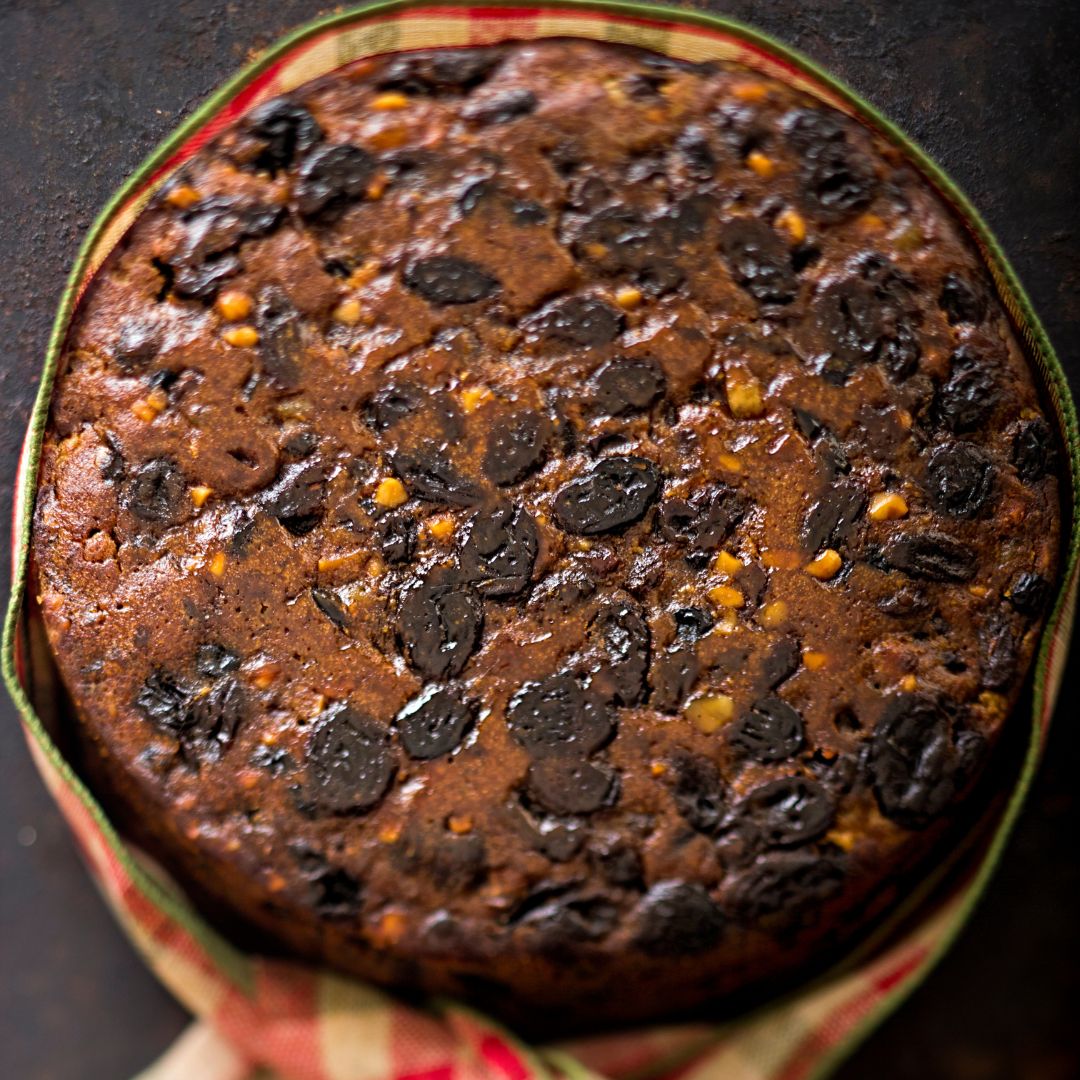
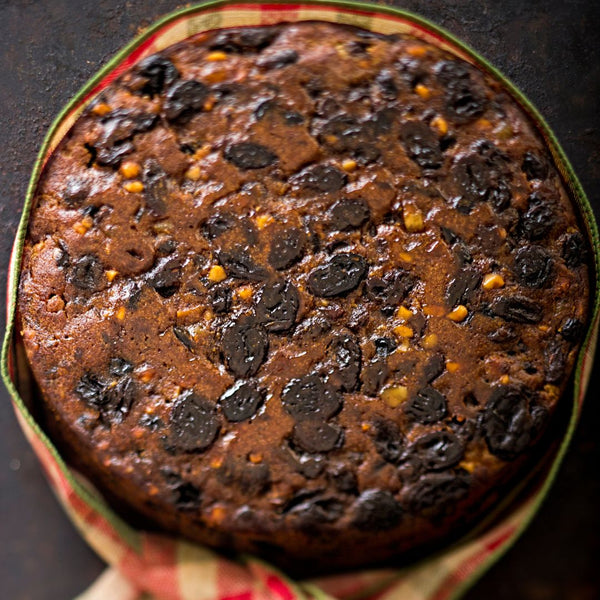
A traditional British Christmas cake is a dense fruit cake made with dried fruit and warm spices. Many recipes use brandy, rum, whisky or sherry and are designed to mature before decorating. Feeding means adding a small, measured amount of alcohol to a fully baked and cooled cake during that maturation period.
Start With A Suitable Recipe
Use a tested fruit-cake recipe that gives its own baking, feeding and storage instructions. Do not assume that an ordinary sponge cake, a very moist fruit cake or an alcohol-free adaptation can be stored in the same way as a traditional alcohol-fed Christmas cake.
Before feeding, the cake must be baked through and completely cold. Warm cake wrapped too soon can trap condensation and create unsuitable storage conditions.
How To Wrap And Store The Cake
- Once completely cold, remove the cake from its tin.
- Wrap it in clean baking parchment or greaseproof paper.
- Add a secure outer layer of foil, keeping foil away from direct contact with the cake where acidic fruit may react with it.
- Place the wrapped cake in a clean, airtight tin or container.
- Store it in a cool, dry place away from sunlight, radiators, ovens and strong odours.
Open the cake only with clean hands and utensils. Rewrap it carefully after every feed and inspect it before adding more liquid.
What Alcohol Can Be Used?
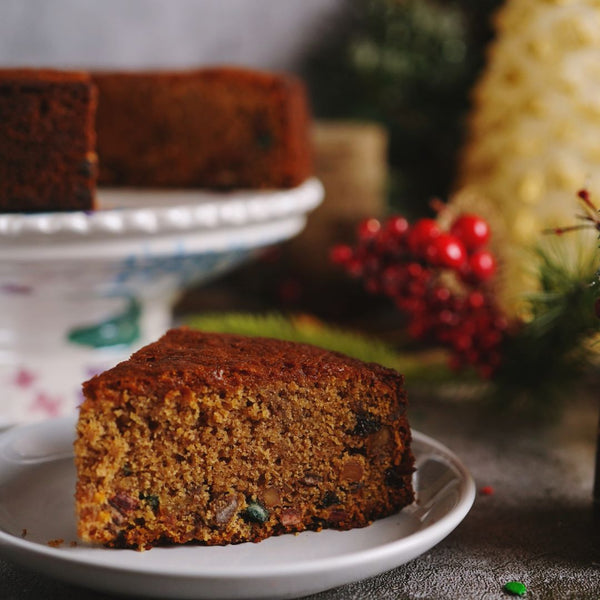
Brandy, rum, whisky and sherry are commonly used because their flavours suit dried fruit and spice. Choose the alcohol specified by the recipe or one with a compatible flavour. Keep alcohol securely away from children and never pour or handle it near a naked flame.
Using stronger alcohol does not guarantee that a cake will remain safe indefinitely. The recipe and storage conditions still matter.
How To Feed A Christmas Cake
- Unwrap the cake and inspect the top, base and sides. Do not continue when there are signs of spoilage.
- Use a clean, thin skewer to make evenly spaced holes without breaking up the cake.
- Add the small quantity stated by the recipe, usually with a clean spoon or pastry brush. More liquid is not better.
- Allow the surface to absorb the alcohol before wrapping the cake again.
- Record the date and amount so the cake is not fed twice by mistake.
A cake that feels saturated, leaves wet residue or smells unexpectedly fermented should not receive more alcohol. Excess feeding can produce a soggy, unstable cake and may mask rather than prevent deterioration.
How Often Should It Be Fed?
Follow the schedule in the tested recipe. Some cakes are fed weekly for a limited maturation period; others need less. Inspect the cake every time and stop feeding before marzipan or icing is applied.
There is no universal rule requiring twelve weeks of feeding. A shorter schedule may be entirely appropriate, particularly for a recipe made closer to Christmas.
Alcohol-Free Christmas Cakes
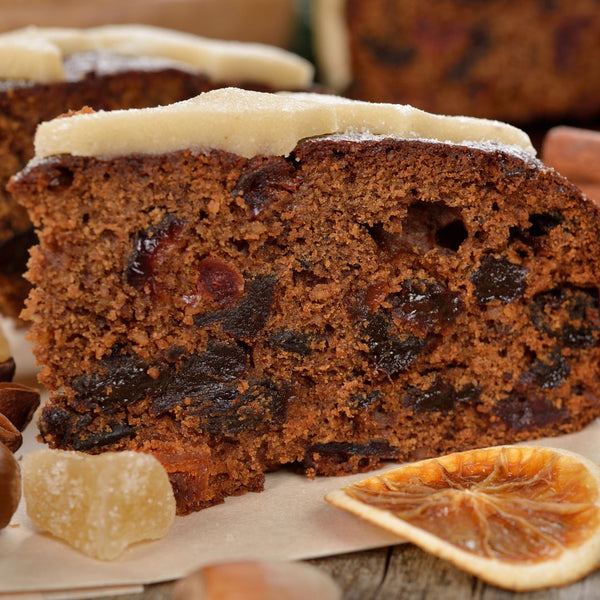
Fruit juice, tea and other non-alcoholic liquids can be used in recipes developed for them, but they do not provide the same storage conditions as alcohol. Do not repeatedly feed an alcohol-free cake with juice and then keep it for weeks at room temperature.
Follow the recipe's refrigeration and use-by guidance. For longer storage, freeze the fully cooled cake promptly in suitable wrapping rather than attempting prolonged room-temperature maturation.
Freezing Christmas Cake
Plain, undecorated fruit cake can often be frozen successfully when wrapped tightly and placed in an airtight container. Quality declines over time, so use the storage period specified by the recipe or freezer guidance rather than relying on a blanket one-year claim. Label the cake with the date and thaw it while still wrapped to limit condensation.
Before Decorating Or Serving
- Stop feeding early enough for the surface to feel dry before adding marzipan or icing.
- Check the cake again for visible mould, off odours or unexpected moisture.
- Tell guests that the cake contains alcohol.
- Check the ingredients and decorations for gluten, eggs, dairy, nuts and other relevant allergens.
- Store the finished cake according to the most perishable component used.
The Practical Rule
Feed a Christmas cake only when the recipe is designed for maturation, use a small measured amount, keep the cake carefully wrapped and inspect it every time. Alcohol is part of the flavour and preservation method, not a substitute for clean handling or sensible storage.
Browse our current Christmas cake collection for cakes available from Anges de Sucre.


Your information was very handy …..will follow it… Thank you so much for every information. God bless you abundantly.
I put a layer of marzipan only on my cake as I didn’t want to put fondant on, it’s soaked in almost, will it spoil on the cake ? I wasn’t thinking 🤦♀️ Also can I still poke holes in to feed it?
I made my Christmas cake on 1st October but I’m not using alcohol to feed it I’m using apple juice instead. Will it spoil before Christmas without the alcohol ? I’m panicking now as we made it for the first time with the children using our late Nanna’s recipe and if it’s ruined they will be so upset
Can you leave your fruit cake in the tin it was baked in whilst feeding to ensure that it is not knocked or damaged during the period in the lead up to when it’s required.
Hi, when feeding my Christmas cake do I need to prick it each time before I feed it
Thank you
Made mary berry’s christmas cake with brandy 2 weeks ago fed it yesterday but it seems moist and a little sticky I have it covered in greaseproof paper and tin foil in my cupboard not sure if it needs to breath or does this seem OK should I leave feeding it now ?
My first time making a Christmas cake in the U.S. at the request of my British husband. I only made the cake 2 weeks ahead of Christmas day. Have fed it with brandy twice (just after cooling, and then again 4 days later). According to Mary Berry’s recipe I should start covering 1 week ahead of serving (which is tomorrow). My question is, can I feed it once more before covering with marzipan? Or do I need to leave it alone several days before covering? I’ve already broken traditional rules by making it so late and feeding it in shorter intervals, so don’t want it to be a total waste. Can’t find the answer to this question anywhere…
How to feed Christmas cake and how often
I’m feeding my cake but it’s moist each time I unwrap it. Is this normal or should I let the air get to it?