
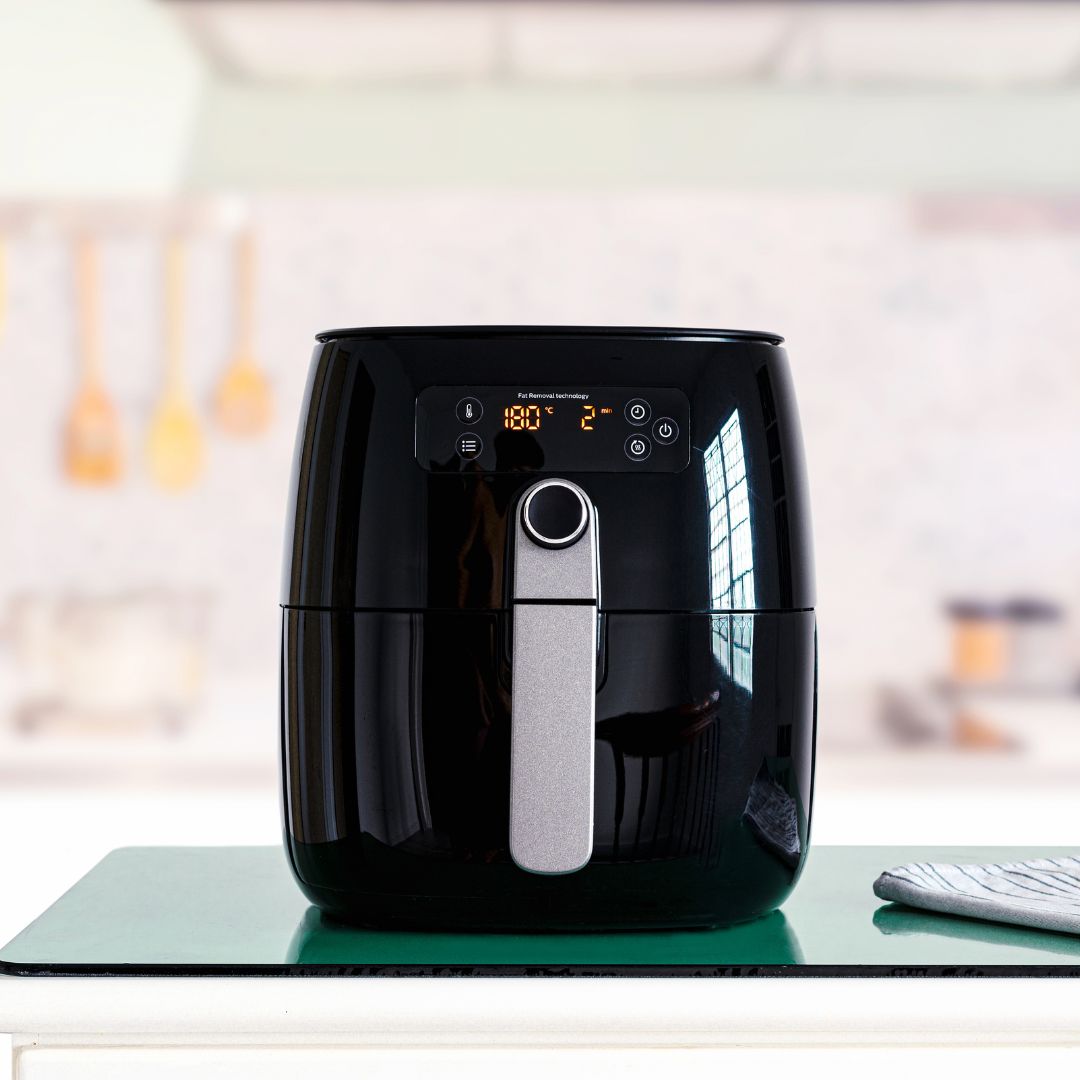
Air fryers. The humble countertop gadget that once played second fiddle to deep fryers, quietly crisping up a batch of last night's chips, has somehow found its way into the world of baking. Brownies, cookies, millionaire shortbread, literally anything can be air fried. But can cake be air fried too?
If you'd told me five years ago that people would be swapping their ovens for a compact, fan-driven fryer to make cake, I’d have raised an eyebrow and clutched my springform tin a little tighter. But here we are. TikTok and Instagram are flooded with videos of golden, lofty sponges emerging from air fryer baskets, home bakers breathless with shock, promising they’ll never use an oven again. Major supermarkets have caught on, launching air-fryer-friendly cake mixes, and brands are selling accessories tailored for these tiny convection ovens. And fans of our cult favourite Hero Sponge Recipe have also given it the air fryer treatment.

So, does it work? Can an air fryer actually produce a cake that’s light, fluffy AND delicious? The answer is yes, but with a few caveats. Like any good magic trick, it requires a little finesse, some well-placed foil, and an understanding of how air frying differs from traditional baking.
The Science of Air Fryer Baking
Baking is alchemy. A transformation where heat, moisture, and a delicate balance of fat, flour, and sugar turn into something magical. The air fryer, however, approaches this process with all the subtlety of a wind tunnel.

Unlike a traditional oven, which uses radiant heat to gently bake your cake from the outside in, the air fryer blasts hot air around the batter at high speed, accelerating cooking times but also making things more unpredictable.
How Air Fryers Differ from Ovens
- Speed: A small air-fryer cavity can bake a cake faster than a full-size oven, but the difference varies enormously by model, tin and recipe. Treat any timing reduction as a starting point and check the cake early.
- Top heat: Many air fryers brown the top of a cake quickly because the heating element and moving air sit close to the surface. That can give you a deeper crust before the centre has finished baking.
- Airflow: Strong circulation can change how quickly the surface sets and how evenly the cake bakes. The useful adjustment is supervision, not a universal formula.
Essentially, an air fryer is eager and efficient, but every model behaves slightly differently.
The Art of Air Fryer Cake Baking: Challenges and Fixes
Air fryers can produce excellent cakes, but start with the appliance manufacturer's guidance and a recipe or tin size that physically suits your machine. Do not assume an oven conversion will behave identically in every air fryer.
-
Dry Cakes:
- Use the recipe as written first rather than automatically adding extra fat or liquid.
- Begin checking for doneness earlier than you would in a conventional oven. A skewer should come out clean or with a few moist crumbs, and the centre should spring back lightly.
- If repeated tests with the same recipe show dryness, shorten the bake or reduce the temperature slightly on the next attempt.
-
Over-Browning:
- If the top colours too quickly, try a slightly lower temperature on the next bake while allowing enough time for the centre to cook.
- Where your appliance manufacturer permits it, a securely fitted loose foil shield can protect the top later in the bake. Keep foil clear of the heating element and never allow it to blow around the basket.
- If your machine has a dedicated bake setting, follow its instructions rather than assuming it uses the same airflow as air-fry mode.
-
Uneven Baking:
- Use a tin that sits level with adequate clearance around it for the airflow specified by the manufacturer.
- Rotate the tin only if your machine can be opened safely mid-bake and you know the cake benefits from it.
- Preheat only when the appliance or recipe calls for it; some models are designed to start from cold.
Advanced Baking Tips
Small, repeatable adjustments are more useful than a single air-fryer conversion rule.
-
Pick the Right Tin:
- Measure the basket or drawer and choose a cake tin that fits comfortably without blocking the required airflow. Six-inch tins suit many machines, but certainly not all of them.
- Metal tins usually give predictable heat transfer. Dark tins can brown edges faster than lighter ones, so judge by the result in your own machine.
-
Modify Recipes Carefully:
- Do not apply a fixed 15°C or 25% conversion to every recipe. If adapting an oven recipe, start conservatively, note the actual temperature and time that worked, and use that as your model-specific baseline.
- For a large quantity of batter, several smaller layers are usually easier to bake evenly than one very deep cake, provided the tins fit safely.
-
Keep a Bake Log:
- Record the air-fryer model, setting, tin size, batter depth, temperature and final bake time. After two or three bakes, that information is far more useful than a generic internet conversion chart.
The Bigger Picture: Why Air Fryer Baking is Trending
We’ve entered an age of convenience baking. The air fryer taps into modern life’s biggest culinary trends: speed, efficiency, and multi-functionality. It’s particularly useful for smaller bakes when heating a full-size oven would be unnecessary.
On social media, air fryer baking has gone viral. Home bakers share clips of golden cakes emerging from compact fryers, supermarket shelves carry air-fryer-friendly baking mixes, and brands sell tins and accessories for different drawer sizes.

The Final Verdict: Oven vs. Air Fryer
So, should you abandon your oven in favour of an air fryer? Not quite. If you’re dreaming of a towering, multi-layered showstopper, a conventional oven gives you much more room and control. But for a small loaf, single sponge or test batch, an air fryer can be genuinely useful.
The important thing is to learn your own machine rather than trust one universal conversion. For more tested baking ideas and techniques, browse our recipes and baking guides.

Comments